Monday, September 3, 2018

Memorial Art Gallery

When a friend visits you in Rochester for the fourth time, it’s a challenge to come up with something new for her to do. Luckily, even though I’ve taken Nanette to the Memorial Art Gallery (MAG) several times, it isn’t a static museum – there’s always something new to see. Plus, they like to rearrange the regular collection, so it’s fun to wander around trying to find our favorite works of art…


This time, my goal was the Josaphine Tota exhibit, which unfortunately closes this coming Clothesline Festival weekend. Tota was a Rochester resident who started painting very late in life. She took classes at the MAG, and evolved from traditional still life and landscapes to her own surrealist expression in egg tempera. Her works are primarily untitled, since she painted for her own enjoyment and therapy. 

a dress form made from
Rota's own body
I loved the irregular shapes of many of her paintings
According to one of the wall panels, “Josaphine Tota rarely discussed her work and left no letters or papers. Nonetheless, this lack of direct knowledge of her artistic intentions does not diminish the formal or psychic potency of her work. Viewers of Tota’s paintings are made privy to the private communications between the artist and herself; no answers are forthcoming.” Nevertheless, the exhibit, curated by Jessica Marten, does provide helpful clues along the way into Tota’s medical ailments and state of mind, which help the viewer understand much of the symbolism.

"Prelude to the Final Solution"
The exhibit that wasn’t my primary goal had a much greater impact on me. “Fabric of Survival – The Story of Esther Nisenthal Krinitz,” curated by Marlene Hamann-Whitmore, is the powerful illustration of the artist’s experience of Nazi occupation of Poland and her survival of the Holocaust through needlework and fabric collages. Each panel is incredibly detailed in its depiction and description of a particular memory, and is intensely moving. Nanette and I watched bits of the 30-minute video with interviews of the artist that accompanies the exhibit, but I really want to go back and use one of the museum’s portable chairs so I can sit and truly appreciate it. This exhibit runs through December 2, so I have time. There will also be a talk on Sunday, September, 16, by her two daughters. 

This is an exhibit not to be missed.
"Coming to America" - I found the last line of the text particularly moving in light of current events: "My dear child, this will be your America!"


Monday, July 23, 2018

Del Lago & Skaneateles

Portico By Fabio Viviani, the restaurant at Del Lago Resort and Casino, has been on my list of restaurants to try since it opened. We’ve been whittling down the list, although we keep adding more (don’t tell my primary physician, since this dining goal seems incompatible with health goals she’s set for me…). We recently had the opportunity for a wine and culinary experience there, and the group also arranged for a good rate at the hotel, so we decided to make a mini-break of it and include a day-trip to Skaneateles.

When I first met Charlie’s family, they kept talking about this lake and town, and a great restaurant called Krebs. Not being Finger-Lakes-educated, I heard “Skinny Atlas,” and thought that was a rather peculiar name. But it was pre-internet, and not only couldn’t I look it up, I had no idea then there was a name for my mishearing – a mondegreen. (Like when a friend of my little brother thought the end of prayers was “Father, Son, and home we go.”)

We did a little morning shopping, then had a delicious lunch at Moro’s Kitchen, a sister restaurant to Moro’s Table in Auburn, which we love. Afterward, we had intended to do a boat tour on the lake, but even if I’d wanted to, the gale force winds had canceled all tours. I was feeling a bit queasy just walking out on the pier and watching the waves crashing against the breakwater! 

Instead, we walked up to The Krebs to have a peek. We will definitely need to return, and perhaps stay a couple of nights at the Mirbeau Inn and Spa, and hope the weather cooperates to get out onto the lake. Part of me wants to take the mailboat tour (I had just seen this video prior to our trip, and it looks like great fun, although I’m not sure how fun it would be in hours 2 and 3…), but the practical part will stick to the 50-minute option. It would be fun to see some of those lake mansions closer up. 

Our room at Del Lago was very comfortable, although even with non-opening windows and the hum of the air conditioner, I could still hear the trucks on the Thruway. We took a spin through the casino, and my only temptation was to take a photo, which Charlie cautioned me against. I don’t understand the entertainment value of casino gambling – none of the people glued to their slot machines looked like they were having fun.

Dinner began with an hour of wine tasting, led by Marti and Tom Macinski, former owners of Standing Stone Vineyards. We tasted 6 wines, all from the Finger Lakes, and all very good, even the Riesling! They shared their knowledge and anecdotes, and at the end, Marti reminded us that she had never tasted several of her wine selections before this event, and that 20 years ago, daring the same would have been unthinkable – the wines might have been undrinkable…

Our family-style salads were wonderful – one of heirloom tomatoes, another of peaches and burrata. One of Portico’s signatures is its mostly locally-sourced ingredients, and the freshness was evident. Our dinners of salmon, chicken, or beef were all excellent, but the truly memorable dish was the side of rigatoni carbonara. The ingredients – pasta, cheese, egg, crispy bacon, and brussels sprouts – are layered in a mason jar and shaken tableside. It was difficult to restrain from making this into the main dish… Dessert was an incredible assortment of cookies, cannoli, macarons, all made in-house, and little cakes, from Leo’s. We retired early and were glad not to have a 40-minute drive home. It would be fun to go back sometime, perhaps before a show at the Vine – I’d love to check out that theatre space!

Friday, July 20, 2018

Auburn Part II - Harriet Tubman House

It took two months for Krista and me to schedule our return visit to Auburn, partly because we couldn’t go on a Monday or Tuesday – Elderberry Pond Restaurant isn’t open for lunch those days! We finally found a lovely Wednesday – not too hot, not too humid. Good thing, too, because most of the one-hour Harriet Tubman tour is outside. 

caption: "The end of slavery did not bring social and
 economic equality. Notice that all of the passengers...are
white, while the attendants are African Americans." Plus ça 
change, plus c'est la même chose...
We arrived at the Harriet Tubman property 45 minutes before the noon tour (there are only 3 guided tours each day, and to visit the one historic structure on the property you must take a tour). That gave us plenty of time to read through the displays in the Visitor Center. Even though I had been here 6 years ago with my Florida friend, Nanette, I had lost most of the details, and was delighted to get reacquainted with her non-Underground Railroad feats during the Civil War, acting as scout, nurse, and spy. And I hadn’t recalled that at a young age, her skull had been fractured by an iron weight which mistakenly hit her instead of its target, and she developed seizures and religious “visions” as a result of her traumatic brain injury, later diagnosed as temporal lobe epilepsy (ah, science…).

Our guide, Rufai Shardow, was from Ghana (as was Tubman’s grandmother), and his personal connection to slavery was very emotional. Ghana lost about 12% of its people to slavery, and 60 forts were constructed on the coast to house the slaves before transit. Rufai grew up in one of these “slave castles,” which had become a prison, where his father worked as a guard.

Although the property opened as a historic site in 1953, it just last year became a National Historic Park, to honor Tubman’s legacy (Rufai mentioned something about Tubman going on the $20 bill, but I told him not to hold his breath with this administration…). And because National Park Service staff are on-site in July and August, there is no admission fee (Park Rangers are not allowed to collect fees). Come September, the Harriet Tubman House staff will take over again, and entry will return to $5. In the meantime, donations of the same are encouraged!

Our tour took a leisurely walk the short distance from the Visitor’s Center to the Tubman Home for the Aged, with frequent stops in the shade along the way for our guide to share his knowledge and observations. Tubman took 13 trips to Maryland to shepherd slaves north – mostly her family members, but sometimes also others whom could trust not to betray her. Auburn, with 100 sites on the Underground Railroad, was a true sanctuary city. Rufai called the Underground Railroad “the most dramatic protest in the history of the country,” and reminded us that slavery still exists, although we now call it “human trafficking.” (for an excellent documentary on the subject, watch Robert Bilheimer’s Not My Life, narrated by Glenn Close). 

The Harriet Tubman Residence is currently being restored, and the NPS plans to open it in two to three years and display the findings from the ongoing archeological digs on the property. This brick structure took Tubman’s family three years to build after their original wood frame house burned. 
This time, I bought fresh eggs, too!
And the owner had a beautiful dog...

One of the placards mentions that when Tubman died in 1913, the New York Times listed her among the 250 most important people to have died that year. Very few on that list would be recognizable 100 years later. At the end of the tour, Krista had the privilege of reading a quote from Booker T. Washington to the group: “Her life is an inspiration to all.” Indeed.

Thursday, July 12, 2018

Aurora & Seneca Falls

Shopping. Eating. Education. A day trip to Aurora and Seneca Falls provides the perfect opportunity for all three.

Mary Beth, one of my NYC friends who is willing to visit “upstate,” and I started at the Mackenzie Childs mother ship, on the east side of Cayuga Lake. Luckily, we were there the weekend before the barn sale (that event is not something I have the fortitude to experience), so the shop was calm and the sales staff friendly and relaxed. I hadn’t intended to buy anything, but there were a few really cute things on pre-sale, and as long as Mary Beth was helping our Finger Lakes economy, I thought I should join her... 

From there, we continued south, to Jane Morgan’s Little House, where we barely had time to say hello to Randi, the owner, and set a couple of things aside before our reservation at the Aurora Inn across the street. Lunch on the veranda overlooking the lake was lovely and delicious. Thus fortified, we re-crossed the busy street and continued our support of the local economy. In the short time it had taken us to eat, Randi and her associate had completely rearranged the front room by relocating all of their black and white (i.e., Mackenzie Childs-like) clothing there, where it would be easily accessible to this weekend’s barn sale hordes. They were also busy sorting handmade button necklaces, many with that signature checkerboard, by color. Although I wanted one in each color, I settled on a plain, but versatile, black and white one.

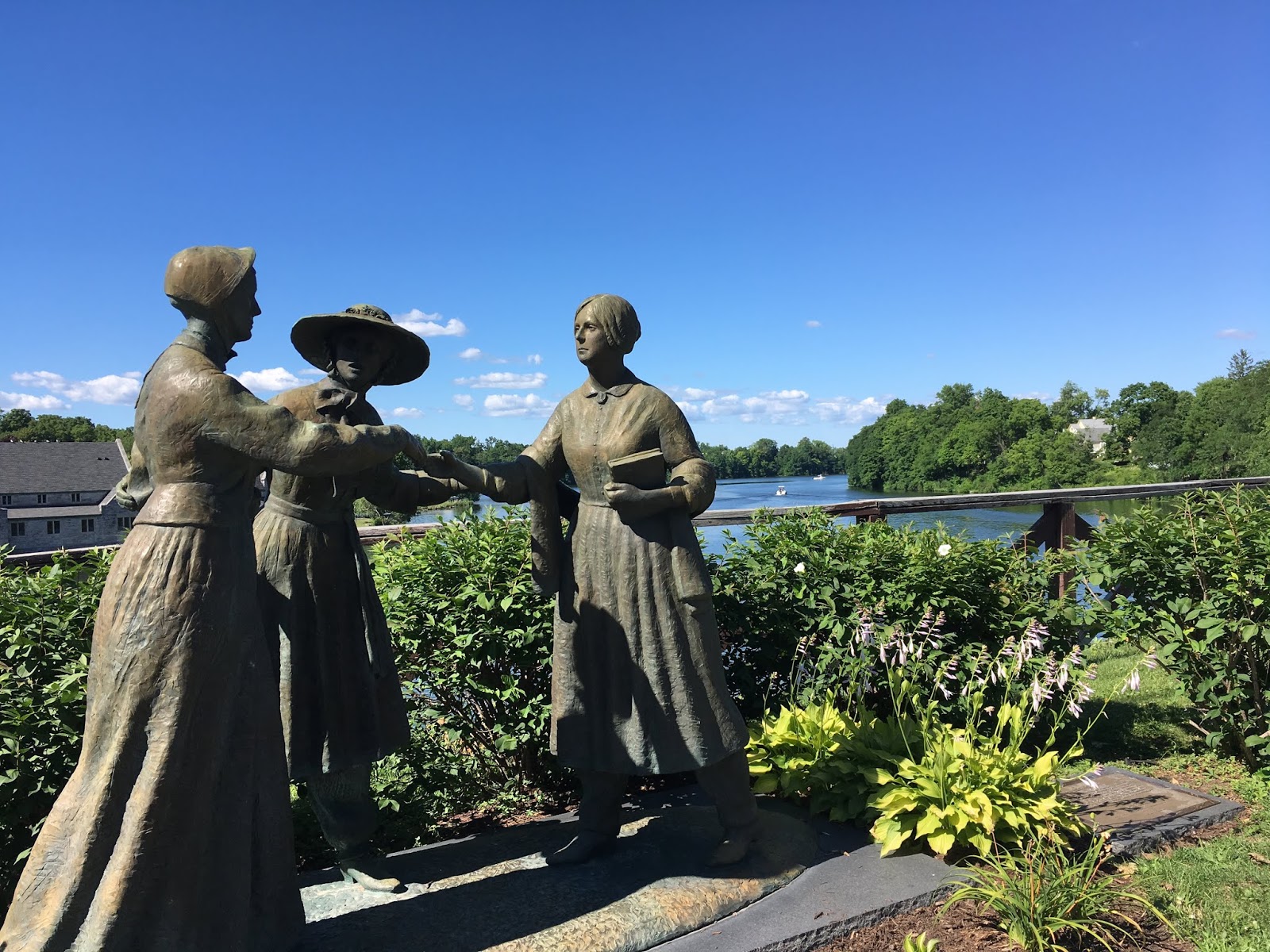
The First Wave Statue Exhibit,
by Lloyd Lillie
Then it was time to be educated in Seneca Falls. Our first stop was the Women’s Rights National Historical Park. We watched the introductory film at the Visitor Center, which was informative, entertaining, and a bit depressing (because equality is a fragile concept, even and especially these days). The exhibits are mostly reading material, and the few children visitors appeared bored, but I was heartened to see several male visitors, as well. 

We peeked into Wesleyan Chapel, the site of the First Women’s Rights Convention (although it is not the same structure as in 1848), and since no one else was there, I tested the acoustics with a short song…

Next stop was the National Women’s Hall of Fame, which was little more than posters on the walls of each of the women inductees – information one could just as easily read on their website, in the comfort of a chair and with a drink in hand. Still, I suppose our admission fee helped support the existence of the organization in some small way.

Our final stop was the Seneca Falls It’s a Wonderful Life Museum, a curious little place which exists on fact that Frank Capra visited the town in November, 1945, while he was working on the film’s script, and the idea that parts of the movie, set in “Bedford Falls,” are based on the town and stories of Seneca Falls. Some of the actors who played children in the film, as well as Frank Capra’s granddaughter, make frequent pilgrimages to Seneca Falls. As I said, curious.

statue commemorating "When Anthony met Stanton"
We tried to visit Elizabeth Cady Stanton House on our way home, but it was closed, and I’m not sure I would try returning – the entrance to their parking lot is so steep that my car was making all sorts of warning sounds going in and out to turn around! This town definitely felt like a “once and done” visit…

Sunday, July 8, 2018

Sam Patch Erie Canal Tour

I can’t believe I haven’t been on the Sam Patch packet boat Erie Canal cruise until this past weekend. It took my friend Mary Beth’s visit from the city to inspire me to this activity, and I can honestly say that I would happily go again with future guests!

Johanna and Grace
We took a 4pm cruise, and I was delighted when one of my Concentus singing sisters, Johanna, boarded with her husband and two toddlers. Our guide, Wyatt Doremus, was informative and also funny, so I really tried to pay attention to his commentary as we made our way west from the Village of Pittsford. Wyatt is fascinating in his own right (click HERE for his bio), and he regaled us with facts and figures, including that 1000 canal builders died of Genesee fever (malaria), and that it took 8 years to dig (dynamite didn’t yet exist) and 11 years to recoup the investment.

Wyatt cautioned us that while many people think they hear the walls of Lock 32 talking to them, saying, “touch me,” it’s not a good idea to heed that call, since the slimy green walls will stain you and clothing, and there’s the risk of body parts getting pinned between the wall and the boat. He also explained that it’s not a good idea to swim in the canal, because of snakes and snapping turtles. I wasn't tempted to do either, but note taken. 

Wyatt and the kids
holding the rope in the lock
It was fascinating to watch the doors close on us when we got to that lock, and to watch and feel the boat rise 25 feet to the level that would allow the next doors to open for us to exit. Wyatt let the passenger children (including Johanna’s eldest) help him hold the rope that kept us from bouncing off the lock walls, and they took their responsibility quite seriously. 

We turned around just west of the lock, and were once again sealed in, and this time lowered, to return to the Village of Pittsford. The tour took us to just east of the village, so we could pass through the Great Embankment. It’s quite something to be eye-level with houses on one side and floating above roofs on the other!

I hadn’t realized that Corn Hill Navigation (CHN), which runs the Sam Patch, is a non-profit. When the Mary Jemison was still in service, they used to provide a discount that enabled the entire 4th grade from the city of Rochester to share this experience. The organization hopes to put a new Mary Jemison in the water next year. That tour will start in Corn Hill and go south on the Genesee. 
Wyatt had fond words for CHN’s visionary, who founded the organization in 1991 and passed away in 2017. Although I didn’t know Ted, this being small-town Rochester, of course I know his wife, Claire. Rochester owes a debt of gratitude to Ted and his family for helping revitalize our section of the canal.

Too soon, we passed back under the Mitchell Road low bridge and were coming to the town... 90 minutes on the Erie Canal!

Friday, June 8, 2018

The Great Escape Room

Back in September 2015, a Great Escape Room opened in Rochester, on University Avenue. I was so excited and wanted to go, but not alone, with a group of strangers, and I couldn’t recruit anyone to go with me. It’s kind of a nerdy thing to do, I guess; the real-life experience is based on computer games. It’s a mix of scavenger hunt and puzzles in a locked room with a timer set to an hour. The goal is to beat the clock and solve all of the puzzles to get out on your own, rather than fail and be let out when the time is up. 

I realized the ‘escape room’ concept had hit mainstream (or even jumped the shark?) when it was the plot of an episode of The Middle. And yet, I still wanted to go, and I still couldn’t recruit anyone! Finally, my Rocappella singing group agreed, but of course scheduling anything with 10+ people is a daunting task. In the meantime, I had bought a Groupon to an imitation Great Escape Room in Henrietta, and by the time I went to use it, right before expiration, the business had shuttered. (Getting a refund from Groupon was impossible –luckily, Paypal came to my rescue!)

Recently, my “ladies night out” group decided to give this a try, and we had 15 women signed up almost immediately, despite the hefty price ($25 per person).  So this week, we put on our thinking caps and entered “The Library” in The Great Escape Room. After a recorded “Sherlock Holmes” gave us some instructions that we didn’t really understand, our room monitor, “Dr. Watson” (Jasmine, a lovely woman studying criminal justice at Brockport), tried to guide us without actually giving us any answers. We had 5 puzzles to solve, each with a different number of clues that were hidden around the room, in and under things, and a couple only visible in the dark. It was rollicking great fun, and while we worked in small groups on each of the puzzles (I naturally gravitated to the math problem…), we also worked together to find and interpret the clues. This room is advertised as the easiest; 35% escape within the hour, and the quickest escape time was about 35 minutes. With probably more assistance from Dr. Watson than other groups get (although, really, who knows?), we happily made it out with 11 minutes to spare.

I was impressed with the creativity and variety of the puzzles. And unnumbered clues that at first  seemed like maddening mistakes on the part of the organizers in fact turned out not to be numbered for a well-thought-out reason. After we emerged victorious, we all agreed we would happily return again and try a more difficult room. Then we went to a nearby restaurant to celebrate!

Thursday, May 31, 2018

Bottle Deposit

Penfield Return Center - bonus: it's 2 doors down
from The Original Steve's diner!
I am no fan of the bottle deposit. It was instituted in the time before curbside recycling, as a means to motivate people to recycle their cans and bottles. Well, some of them. It has always been an arbitrary, hypocritical, and political endeavor. I don’t recall, for example, there ever having been a deposit on returnable wine or liquor bottles in states where I’ve lived and drunk… Different states slap varying deposits on different types of containers. But sticking to New York, the current law is a nickel deposit on the following: carbonated soft drinks, soda water, beer and other malt beverages, mineral water (carbonated and non-carbonated), wine products, and water which does not contain sugar, including flavored or nutritionally enhanced water. But not on: milk products, wine and liquor, hard ciders, tea, sports drinks, juice, drink boxes, or waters containing sugar.

So why is there a deposit on a bottle of Coke but not a bottle of Snapple? If the bill really is intended to motivate recycling, why not all cans and bottles? And is a nickel enough motivation to get people to take all their returnable bottles and cans back, instead of putting them in their curbside recycling (or trash)? Obviously not, or the economics of the deposit wouldn’t work. And obviously not, from the number of houseguests I’ve had who throw all their empties in our general recycling bin for me to pick out… Or all the bottles collected by the homeless and returned by the hundreds at Wegmans on East Avenue...

I recently got fed up with having to remember which bottles we purchased at Wegman’s vs. Walmart vs. Beers of the World. You have to know that, because if it isn’t sold at a particular store, it isn’t returnable there, either. And I got fed up with feeding my containers one by one into Wegmans’ machines, which takes about 20 seconds per container, and that’s if it doesn’t reject it unnecessarily (their tiny water bottles take particular finesse at inserting, and some of the items they sell get rejected no matter what, and you have to take them in to Customer Service). And I got fed up with having an odd assortment of bottles that didn’t come from Wegmans littering up the garage. So I finally went to the Return Center in Penfield, where not only do they take all returnable bottles, they also do the sorting for you, and I got my money for my 84 containers within a minute of entering the store, without getting my fingers sticky (some cans don’t get rinsed quite as diligently…).

I asked the young man how much the redemption center was reimbursed for returns, and he informed me it’s between 6 and 8 cents, depending on the type of container and manufacturer. Hm. The deposit math is somewhat opaque. It reminds me of Milo Minderbinder’s scheme in Catch 22, summed up in Closing Time: “…he contrived the fruitful and abstruse financial strategies for buying fresh Italian eggs from Sicily in Malta for five cents apiece and selling them to his mess hall in Pianosa for five cents apiece at a handsome profit that increased the squadron’s capital supply, in which everybody had a share…” Because all along the way, businesses and the State are making money.

Until 2009, beer and soda distributors kept all the net nickels of unreturned bottles. Since then, 4 of every 5 cents of unclaimed deposits is remitted to the NYS Department of Taxation. This scheme only works if there is leakage – if there are enough lazy people who don’t bother to get their deposits back. According to an article in the Democrat & Chronicle on 12/20/17, New York collected more than $102 million in 5-cent deposits that went unclaimed during the state's 2016 fiscal year, … (amounting) to more than 2 billion recyclable containers that went unreturned in a single year.” That’s an enormous additional tax on consumers. Somehow, I don’t think the program is motivating what it’s meant to be motivating… 

For other attempts at explaining this convoluted system, see:
https://www.syracuse.com/news/index.ssf/2009/11/new_yorks_bottle_deposit_creat.html
or
https://www.dec.ny.gov/chemical/57687.html