Monday, October 22, 2018

"Thurgood" at Geva Theatre


“Thurgood” was the production in Geva’s season I was most looking forward to, and it did not disappoint. The one-man play, by George Stevens, Jr., focuses primarily on Thurgood Marshall’s accomplishments leading up to his being appointed to the Supreme Court. Lester Purry, as directed by Lou Bellamy, carries the almost 2-hour show (plus an intermission) seamlessly, and encourages audience input and applause at appropriate moments (a different audience demographic might need less encouragement, but alas, today’s traditional theatre audience has been trained to respect the fourth wall, and it’s hard to break through, even when invited). I was riveted.

Charles Isherwood’s New York Times review of the 2008 Broadway production was polite, but less than enthusiastic, calling the play “essentially an opportunity to watch a movie star deliver a history lecture” and a “superficially dry evening of theater.” He commented about the play through the lens of then-current events: “the presidential candidacy of Senator Barack Obama putting a renewed focus on the legacy of racism, as it is viewed by Americans both black and white, the play serves as a healthy reminder that separate drinking fountains, to cite one shameful practice, are just a generation or two in the past.” 

Unfortunately, Americans continue to need these history lectures, especially as the dark underbelly of racism and hatred has been returned to the light by our current President. MAGA is a blatant nod to the era of white supremacy that his supporters want to return to. A passage late in the play “serve(s) as a stark reminder of how radically the court evolves over the years as its makeup changes.” And this was before the Republican Party hijacked the nomination of Justice Scalia’s replacement and then threw out all future attempts at bipartisanship by changing the number of votes needed to confirm a Supreme Court judge (to be fair, the Democrats aren't blameless - they went "nuclear" for other nominees several years earlier). Only time will tell if Democrats are rightly afraid of the regressive potential Kavenaugh’s recent divisive appointment provides.

There were many moving moments during the play, but perhaps the most moving came at the end, when the play quotes lines of the Langston Hughes’ poem “Let America Be America Again.” Not surprisingly, my high school AmLit class didn’t include this poet, so I googled it to read it in its entirety: READ HERE. Wow. 

Kudos to Geva for giving us this play this season. The fact that this story of racism still resonates makes me wonder if, sadly, there will never be a time when it does not.

“Thurgood” runs through November 18. More info at: www.geva.org

Friday, October 5, 2018

Subscription Addiction

My addiction to performing arts subscriptions began in my late 20s-early 30s in New York City, when, despite not loving opera, I subscribed to both the Metropolitan and the New York City Operas!? Those quickly gave way to the ballet (mostly New York City Ballet, which I maintained throughout my temporary move to London and only reluctantly gave up after moving to Rochester) and theatre (Manhattan Theatre Company and Roundabout Theatre). In Morristown, we subscribed to a performing arts center that presented a mix of performances: dance, comedy, concerts (classical and pop), etc. It was one of the things I missed most moving to Rochester. 

Early on I realized the benefits of subscribing: locking in your preferred seats, theoretically getting the best ticket price (although a poor-selling stinker might end up selling tickets cheaper, since theatre seats are wasting assets; and as I’ve gotten more educated about non-profit arts organizations, I’ve felt a moral obligation to make donations to them to help offset the discount, because I am lucky to be able), and getting preferred access to add-on shows. In 2014, between subscriptions and additional shows I couldn’t live without, I attended my all-time high in a calendar year: 66 performances. (And that didn’t include the ones I performed in as a member of a chorus.)

This season (which corresponds to school, not calendar year) I’m taking it to new heights; in addition to the usual subscriptions at Geva, RPO (half classical, half pops), Eastman Presents, and Nazareth (mostly Rochester City Ballet (RCB), but not exclusively) … Blackfriars Theatre beckoned. That comes to almost 30 performances, before I starting adding and subtracting (yes, there is one show at Geva I will give our tickets away for, since we saw it on Broadway and didn’t enjoy it then; and there’s an RPO concert I probably won’t get to hear, but that’s the subject of a future blog…). Charlie is a peach to come along for the ride on most of these, although he draws the line at dance and more than one theatre subscription.

Shaw Festival Artistic Director Program Notes
I love sitting in a hall with lots of strangers and experiencing a live performance together. I love turning off my cell phone for an hour or two, and turning my mind from current events to let it be entertained and transported for a brief moment. I love a memorably good show, and even the memorably bad ones can provide laughs for years to come. I love my thick folder of tickets to performances to look forward to that will slowly deplete as we inch towards May. Mostly, I love my role as audience!

Sunday, September 9, 2018

Niagara-on-the-Lake

How great is it to live just under a 2-hour drive from an incredibly gorgeous town in another country? This was my third time to Niagara-on-the-Lake (NOTL): the first was in 2009, as part of a “Maggie Tours” bike trip (Charlie’s least favorite bike “organization,” since it means he schlepps the bikes…), and the second was in 2014 after an overnight at the Inn on the Twenty, where we met up with my other regular bridge partner and her husband. 

NOTL can be done as a day trip from Rochester, and when Nanette planned her recent visit north around going to the Shaw Festival, we almost did that, but ended up spending two nights there, to give us time to wander around the town and also play in a regional bridge tournament in St. Catherine’s. 

Nine years ago, the “tour” included an extremely forgettable play at the Shaw Festival, but I chose it because it fit with our biking schedule. This year, Nanette chose two shows, again, based on what would be playing the Wednesday of her visit. Neither one of the shows was forgettable, although The Baroness and the Pig was truly awful. As we sat in the park, recovering from the blistering heat and admiring the view of the Niagara River meeting Lake Ontario, we shared our personal reviews before Nanette checked professional ones on her phone. We were spot on! 

The other show, Oh What a Lovely War, was an intriguing and powerful revue loosely telling the story of World War I from a distinctly Canadian point of view. Although it was written several decades ago, it included some personal stories by the actors, as well as references to current events (my favorite – the Russian official telling the British, American, and French officials that they were all puppets!). There were pointed references to the slights to indigenous people, Negroes, and women (suffrage in Canada was achieved piecemeal, starting in 1917, but wasn't fully inclusive of Asians and Inuit until the 1950s), and more than one jab at America (e.g., always arriving late to the war). There were multiple acknowledgements of the "First Nations peoples," thanking them for their "stewardship of these lands" and "their ongoing and important roles in the caretaking of the lands beneath our feet" (lands which were stolen from the indigenous people in Canada and the United States...).

All of the actors displayed great versatility as they quickly changed characters from sketch to sketch. Nanette and I occasionally had trouble with the French and Russian accents, but we got the gist of it. 

The most moving part of attending the Shaw Festival was the playbill message from Artistic Director Tim Carroll. Definitely worth reading in full, rather than me quoting an excerpt. 


one of my favorite dress shops!
We also did our bit to help support the local economy – we both bought some lovely Canadian clothes and assorted other trinkets, and we had some delicious meals. I mustn’t wait another 4-5 years before going back next time!

Monday, September 3, 2018

Memorial Art Gallery

When a friend visits you in Rochester for the fourth time, it’s a challenge to come up with something new for her to do. Luckily, even though I’ve taken Nanette to the Memorial Art Gallery (MAG) several times, it isn’t a static museum – there’s always something new to see. Plus, they like to rearrange the regular collection, so it’s fun to wander around trying to find our favorite works of art…


This time, my goal was the Josaphine Tota exhibit, which unfortunately closes this coming Clothesline Festival weekend. Tota was a Rochester resident who started painting very late in life. She took classes at the MAG, and evolved from traditional still life and landscapes to her own surrealist expression in egg tempera. Her works are primarily untitled, since she painted for her own enjoyment and therapy. 

a dress form made from
Rota's own body
I loved the irregular shapes of many of her paintings
According to one of the wall panels, “Josaphine Tota rarely discussed her work and left no letters or papers. Nonetheless, this lack of direct knowledge of her artistic intentions does not diminish the formal or psychic potency of her work. Viewers of Tota’s paintings are made privy to the private communications between the artist and herself; no answers are forthcoming.” Nevertheless, the exhibit, curated by Jessica Marten, does provide helpful clues along the way into Tota’s medical ailments and state of mind, which help the viewer understand much of the symbolism.

"Prelude to the Final Solution"
The exhibit that wasn’t my primary goal had a much greater impact on me. “Fabric of Survival – The Story of Esther Nisenthal Krinitz,” curated by Marlene Hamann-Whitmore, is the powerful illustration of the artist’s experience of Nazi occupation of Poland and her survival of the Holocaust through needlework and fabric collages. Each panel is incredibly detailed in its depiction and description of a particular memory, and is intensely moving. Nanette and I watched bits of the 30-minute video with interviews of the artist that accompanies the exhibit, but I really want to go back and use one of the museum’s portable chairs so I can sit and truly appreciate it. This exhibit runs through December 2, so I have time. There will also be a talk on Sunday, September, 16, by her two daughters. 

This is an exhibit not to be missed.
"Coming to America" - I found the last line of the text particularly moving in light of current events: "My dear child, this will be your America!"


Monday, July 23, 2018

Del Lago & Skaneateles

Portico By Fabio Viviani, the restaurant at Del Lago Resort and Casino, has been on my list of restaurants to try since it opened. We’ve been whittling down the list, although we keep adding more (don’t tell my primary physician, since this dining goal seems incompatible with health goals she’s set for me…). We recently had the opportunity for a wine and culinary experience there, and the group also arranged for a good rate at the hotel, so we decided to make a mini-break of it and include a day-trip to Skaneateles.

When I first met Charlie’s family, they kept talking about this lake and town, and a great restaurant called Krebs. Not being Finger-Lakes-educated, I heard “Skinny Atlas,” and thought that was a rather peculiar name. But it was pre-internet, and not only couldn’t I look it up, I had no idea then there was a name for my mishearing – a mondegreen. (Like when a friend of my little brother thought the end of prayers was “Father, Son, and home we go.”)

We did a little morning shopping, then had a delicious lunch at Moro’s Kitchen, a sister restaurant to Moro’s Table in Auburn, which we love. Afterward, we had intended to do a boat tour on the lake, but even if I’d wanted to, the gale force winds had canceled all tours. I was feeling a bit queasy just walking out on the pier and watching the waves crashing against the breakwater! 

Instead, we walked up to The Krebs to have a peek. We will definitely need to return, and perhaps stay a couple of nights at the Mirbeau Inn and Spa, and hope the weather cooperates to get out onto the lake. Part of me wants to take the mailboat tour (I had just seen this video prior to our trip, and it looks like great fun, although I’m not sure how fun it would be in hours 2 and 3…), but the practical part will stick to the 50-minute option. It would be fun to see some of those lake mansions closer up. 

Our room at Del Lago was very comfortable, although even with non-opening windows and the hum of the air conditioner, I could still hear the trucks on the Thruway. We took a spin through the casino, and my only temptation was to take a photo, which Charlie cautioned me against. I don’t understand the entertainment value of casino gambling – none of the people glued to their slot machines looked like they were having fun.

Dinner began with an hour of wine tasting, led by Marti and Tom Macinski, former owners of Standing Stone Vineyards. We tasted 6 wines, all from the Finger Lakes, and all very good, even the Riesling! They shared their knowledge and anecdotes, and at the end, Marti reminded us that she had never tasted several of her wine selections before this event, and that 20 years ago, daring the same would have been unthinkable – the wines might have been undrinkable…

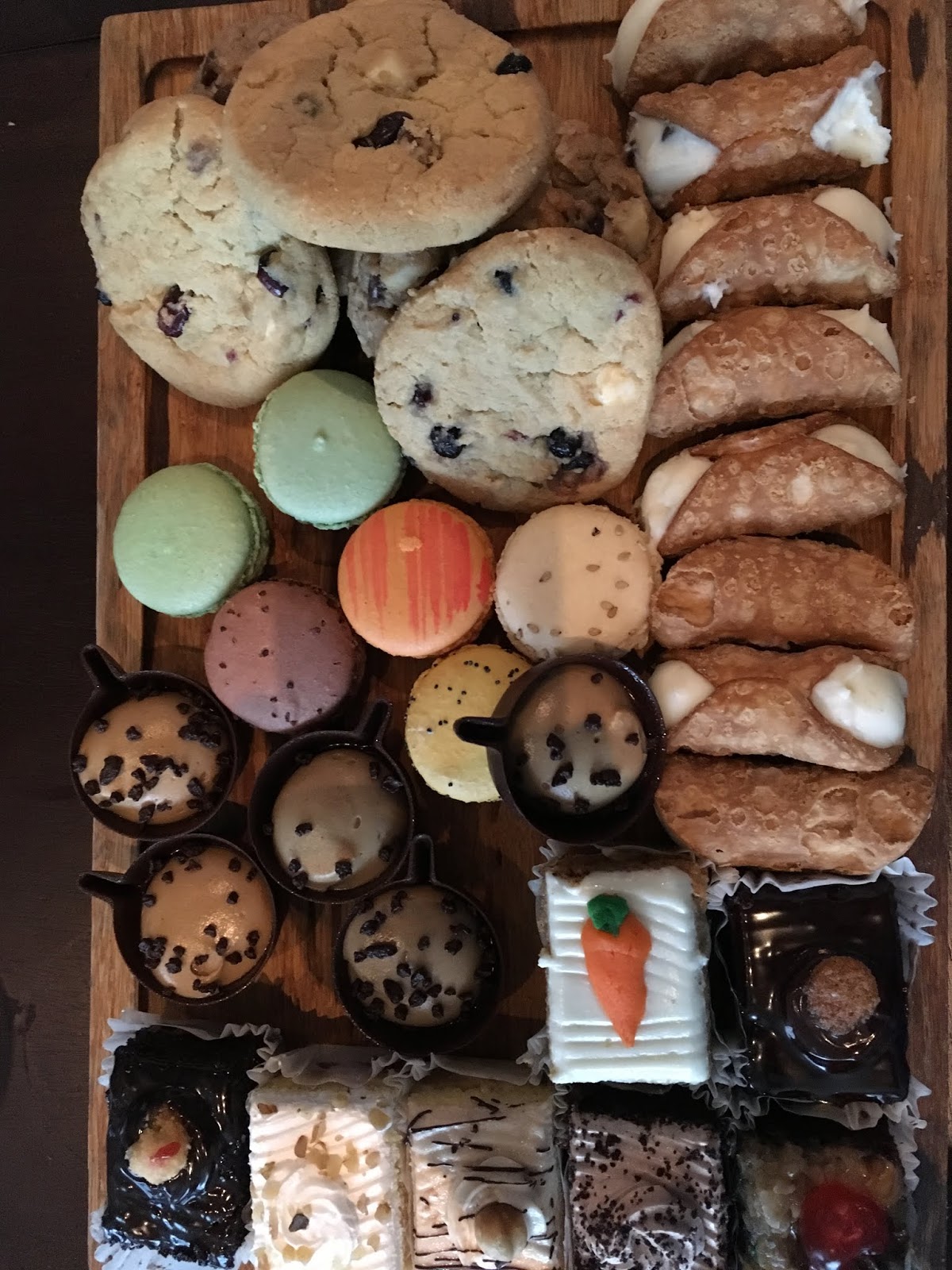
Our family-style salads were wonderful – one of heirloom tomatoes, another of peaches and burrata. One of Portico’s signatures is its mostly locally-sourced ingredients, and the freshness was evident. Our dinners of salmon, chicken, or beef were all excellent, but the truly memorable dish was the side of rigatoni carbonara. The ingredients – pasta, cheese, egg, crispy bacon, and brussels sprouts – are layered in a mason jar and shaken tableside. It was difficult to restrain from making this into the main dish… Dessert was an incredible assortment of cookies, cannoli, macarons, all made in-house, and little cakes, from Leo’s. We retired early and were glad not to have a 40-minute drive home. It would be fun to go back sometime, perhaps before a show at the Vine – I’d love to check out that theatre space!

Friday, July 20, 2018

Auburn Part II - Harriet Tubman House

It took two months for Krista and me to schedule our return visit to Auburn, partly because we couldn’t go on a Monday or Tuesday – Elderberry Pond Restaurant isn’t open for lunch those days! We finally found a lovely Wednesday – not too hot, not too humid. Good thing, too, because most of the one-hour Harriet Tubman tour is outside. 

caption: "The end of slavery did not bring social and
 economic equality. Notice that all of the passengers...are
white, while the attendants are African Americans." Plus ça 
change, plus c'est la même chose...
We arrived at the Harriet Tubman property 45 minutes before the noon tour (there are only 3 guided tours each day, and to visit the one historic structure on the property you must take a tour). That gave us plenty of time to read through the displays in the Visitor Center. Even though I had been here 6 years ago with my Florida friend, Nanette, I had lost most of the details, and was delighted to get reacquainted with her non-Underground Railroad feats during the Civil War, acting as scout, nurse, and spy. And I hadn’t recalled that at a young age, her skull had been fractured by an iron weight which mistakenly hit her instead of its target, and she developed seizures and religious “visions” as a result of her traumatic brain injury, later diagnosed as temporal lobe epilepsy (ah, science…).

Our guide, Rufai Shardow, was from Ghana (as was Tubman’s grandmother), and his personal connection to slavery was very emotional. Ghana lost about 12% of its people to slavery, and 60 forts were constructed on the coast to house the slaves before transit. Rufai grew up in one of these “slave castles,” which had become a prison, where his father worked as a guard.

Although the property opened as a historic site in 1953, it just last year became a National Historic Park, to honor Tubman’s legacy (Rufai mentioned something about Tubman going on the $20 bill, but I told him not to hold his breath with this administration…). And because National Park Service staff are on-site in July and August, there is no admission fee (Park Rangers are not allowed to collect fees). Come September, the Harriet Tubman House staff will take over again, and entry will return to $5. In the meantime, donations of the same are encouraged!

Our tour took a leisurely walk the short distance from the Visitor’s Center to the Tubman Home for the Aged, with frequent stops in the shade along the way for our guide to share his knowledge and observations. Tubman took 13 trips to Maryland to shepherd slaves north – mostly her family members, but sometimes also others whom could trust not to betray her. Auburn, with 100 sites on the Underground Railroad, was a true sanctuary city. Rufai called the Underground Railroad “the most dramatic protest in the history of the country,” and reminded us that slavery still exists, although we now call it “human trafficking.” (for an excellent documentary on the subject, watch Robert Bilheimer’s Not My Life, narrated by Glenn Close). 

The Harriet Tubman Residence is currently being restored, and the NPS plans to open it in two to three years and display the findings from the ongoing archeological digs on the property. This brick structure took Tubman’s family three years to build after their original wood frame house burned. 
This time, I bought fresh eggs, too!
And the owner had a beautiful dog...

One of the placards mentions that when Tubman died in 1913, the New York Times listed her among the 250 most important people to have died that year. Very few on that list would be recognizable 100 years later. At the end of the tour, Krista had the privilege of reading a quote from Booker T. Washington to the group: “Her life is an inspiration to all.” Indeed.

Thursday, July 12, 2018

Aurora & Seneca Falls

Shopping. Eating. Education. A day trip to Aurora and Seneca Falls provides the perfect opportunity for all three.

Mary Beth, one of my NYC friends who is willing to visit “upstate,” and I started at the Mackenzie Childs mother ship, on the east side of Cayuga Lake. Luckily, we were there the weekend before the barn sale (that event is not something I have the fortitude to experience), so the shop was calm and the sales staff friendly and relaxed. I hadn’t intended to buy anything, but there were a few really cute things on pre-sale, and as long as Mary Beth was helping our Finger Lakes economy, I thought I should join her... 

From there, we continued south, to Jane Morgan’s Little House, where we barely had time to say hello to Randi, the owner, and set a couple of things aside before our reservation at the Aurora Inn across the street. Lunch on the veranda overlooking the lake was lovely and delicious. Thus fortified, we re-crossed the busy street and continued our support of the local economy. In the short time it had taken us to eat, Randi and her associate had completely rearranged the front room by relocating all of their black and white (i.e., Mackenzie Childs-like) clothing there, where it would be easily accessible to this weekend’s barn sale hordes. They were also busy sorting handmade button necklaces, many with that signature checkerboard, by color. Although I wanted one in each color, I settled on a plain, but versatile, black and white one.

The First Wave Statue Exhibit,
by Lloyd Lillie
Then it was time to be educated in Seneca Falls. Our first stop was the Women’s Rights National Historical Park. We watched the introductory film at the Visitor Center, which was informative, entertaining, and a bit depressing (because equality is a fragile concept, even and especially these days). The exhibits are mostly reading material, and the few children visitors appeared bored, but I was heartened to see several male visitors, as well. 

We peeked into Wesleyan Chapel, the site of the First Women’s Rights Convention (although it is not the same structure as in 1848), and since no one else was there, I tested the acoustics with a short song…

Next stop was the National Women’s Hall of Fame, which was little more than posters on the walls of each of the women inductees – information one could just as easily read on their website, in the comfort of a chair and with a drink in hand. Still, I suppose our admission fee helped support the existence of the organization in some small way.

Our final stop was the Seneca Falls It’s a Wonderful Life Museum, a curious little place which exists on fact that Frank Capra visited the town in November, 1945, while he was working on the film’s script, and the idea that parts of the movie, set in “Bedford Falls,” are based on the town and stories of Seneca Falls. Some of the actors who played children in the film, as well as Frank Capra’s granddaughter, make frequent pilgrimages to Seneca Falls. As I said, curious.

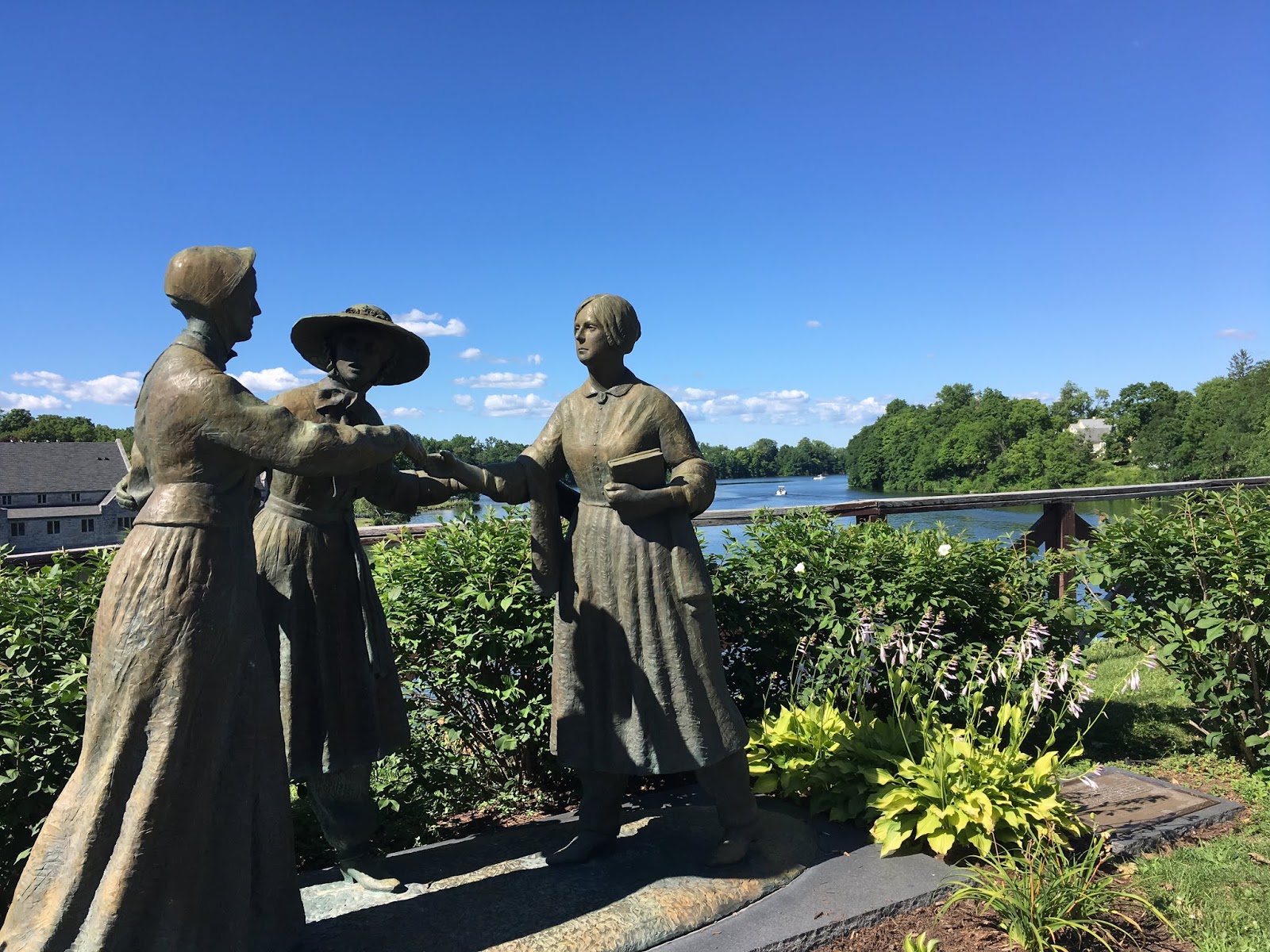
statue commemorating "When Anthony met Stanton"
We tried to visit Elizabeth Cady Stanton House on our way home, but it was closed, and I’m not sure I would try returning – the entrance to their parking lot is so steep that my car was making all sorts of warning sounds going in and out to turn around! This town definitely felt like a “once and done” visit…